
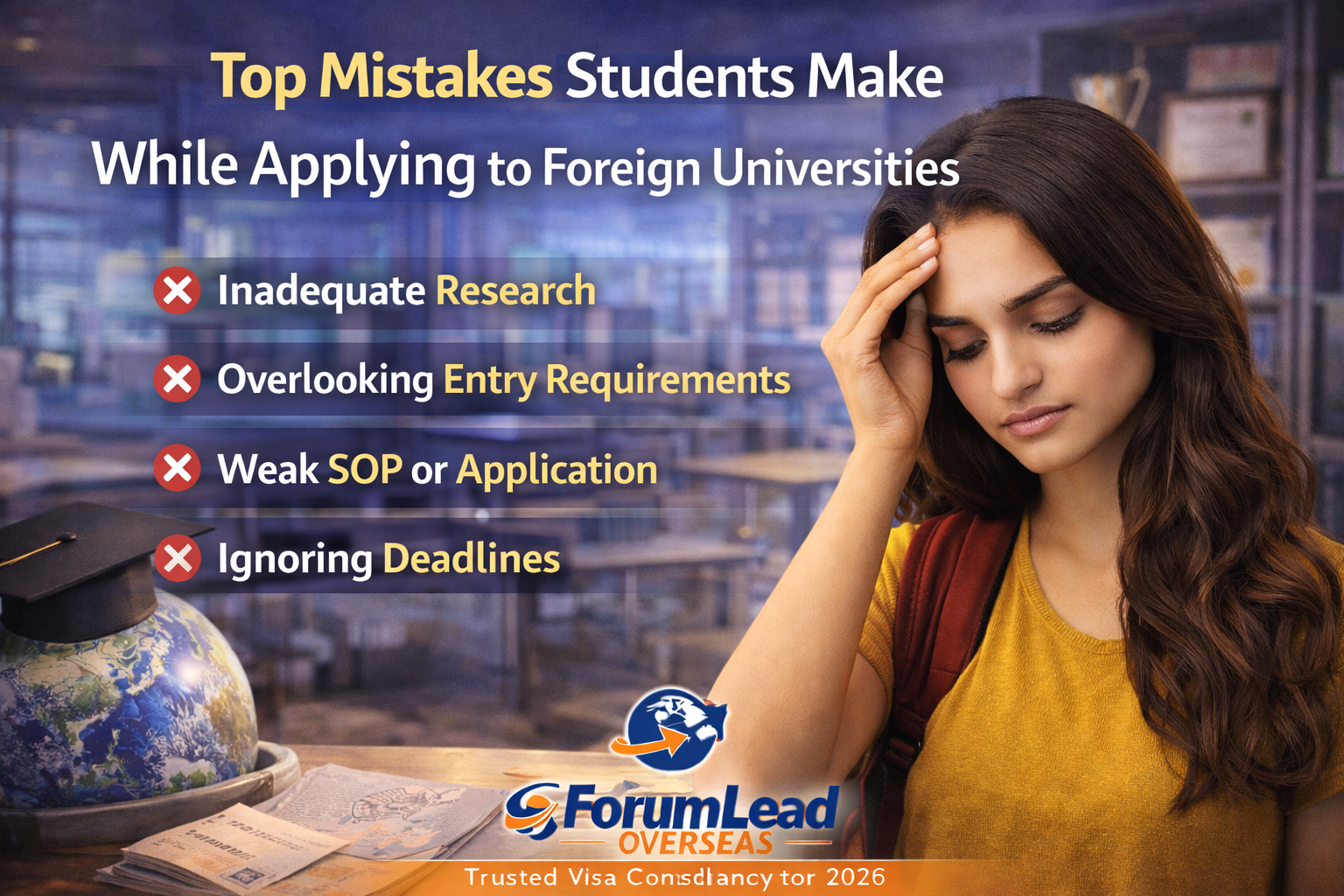
Applying to foreign universities is an exciting yet complex journey. For many students, it represents independence, global exposure, and better career prospects. However, the application process involves multiple stages — selecting the right university, preparing documents, meeting deadlines, securing financial proof, and applying for a student visa.
Unfortunately, many students make avoidable mistakes during this process. These errors can lead to rejections, delays, financial loss, or missed opportunities. Understanding these common mistakes can help students prepare better and improve their chances of success.
In this blog, we will explore the top mistakes students make while applying to foreign universities and how professional guidance from the best student visa consaltency can help avoid them.
One of the most common mistakes students make is choosing a country based on trends rather than personal suitability. Just because a country is popular does not mean it is the right fit for everyone.
Students often overlook important factors such as:
Tuition fees
Cost of living
Visa approval rates
Post-study work opportunities
Immigration policies
Job market demand
Without proper research, students may struggle financially or face visa challenges later. It is important to evaluate your academic background, budget, and career goals before selecting a destination.
Another major mistake is choosing a course that does not align with previous education or future goals. Visa officers carefully review academic progression. If the selected program appears unrelated to past studies, it may raise concerns.
For example:
Switching to a completely unrelated field without explanation
Choosing a lower-level qualification after completing a higher degree
Applying for a course without understanding its career relevance
A logical academic progression strengthens both university admission and visa approval chances.
Every university has specific admission criteria. Some require certain GPA levels, English proficiency scores, portfolios, or prerequisite subjects.
Students sometimes:
Apply without checking eligibility
Submit incomplete documents
Ignore specific instructions
Miss mandatory requirements
This leads to unnecessary rejections. Carefully reviewing university guidelines before applying is essential.
The Statement of Purpose is one of the most critical components of a university application. Many students underestimate its importance and submit generic or copied content.
Common SOP mistakes include:
Using copied templates
Writing vague career goals
Not explaining course selection clearly
Failing to address study gaps
Grammatical errors
A strong SOP should reflect your personality, academic journey, and clear future plans. Professional guidance from the best student visa consaltency can help craft a compelling and personalized SOP.
Foreign universities follow strict application timelines. Missing a deadline can result in losing a semester or even a full academic year.
Students often delay:
Preparing documents
Booking English tests
Submitting applications
Paying application fees
Proper time management is essential. Creating a checklist and planning in advance can prevent unnecessary stress.
Financial documentation is one of the most important aspects of studying abroad. Many students underestimate the total cost of education and living expenses.
Common financial mistakes include:
Not maintaining required bank balance
Providing unclear income proof
Making sudden large deposits before visa application
Not understanding currency conversion requirements
Financial instability can lead to visa rejection. Proper planning ensures smooth processing.
Small mistakes in visa application forms can create serious complications. Inconsistent information, incorrect dates, or mismatched data can cause delays or refusal.
Common errors include:
Wrong passport details
Incorrect academic history
Missing required documents
Providing inconsistent answers
Working with the best student visa consaltency ensures accurate form submission and thorough document review.
For countries like the USA, visa interviews are mandatory. Many students underestimate the importance of preparation and assume their documents are enough.
Mistakes during interviews include:
Nervousness
Unclear answers
Lack of knowledge about chosen course
Inability to explain financial sources
Mock interview practice and professional training significantly improve confidence and clarity.
Each country has unique visa policies. Students who fail to understand these rules may face complications.
Important aspects to consider include:
Genuine student requirements
Work rights during study
Post-study work permits
Visa extension rules
Financial documentation standards
Lack of awareness can lead to rejection or legal complications.
Many students try to manage the entire process independently without understanding the complexity involved. While self-application is possible, it increases the risk of mistakes.
Professional counselors provide:
Personalized profile evaluation
Course and country comparison
Document verification
Financial planning guidance
Visa interview preparation
Choosing the best student visa consaltency provides structured guidance and reduces the chances of costly errors.
Some students apply to only one or two universities, assuming they will receive admission. This is risky.
A balanced application strategy should include:
Dream universities
Target universities
Safe options
Having multiple options increases the probability of admission.
Visa officers and universities expect students to have clear academic and career goals. Applying without a defined plan can weaken your application.
Students should clearly understand:
Why they chose the course
How it connects to past education
What career opportunities it offers
How it benefits long-term growth
A clear vision builds confidence and credibility.
Applying to foreign universities is a detailed and competitive process. Small mistakes can lead to delays, rejection, or financial loss. Proper research, accurate documentation, strong SOP writing, financial clarity, and interview preparation are all essential for success.
Avoiding these common mistakes can significantly improve your chances of admission and visa approval. Seeking professional support from the best student visa consaltency ensures that every step is handled carefully and strategically.
With expert guidance, structured planning, and careful preparation, your study abroad dream can become a successful reality. Remember, preparation is not just about submitting documents — it is about presenting a clear, credible, and confident academic journey.
Your global future begins with smart decisions today.

July 27, 2022
July 27, 2022
July 27, 2022
Forumlead Ovеrѕеаѕ Educational Consultants іn Hyderabad іѕ a оnе-ѕtор solution for аll your іntеrnаtіоnаl ѕtudу needs. Forumlead Indіа wаѕ еѕtаblіѕhеd with the ѕоlе mоttо оf providing quality guіdаnсе аnd thе right еduсаtіоnаl path to the ѕtudеntѕ whо іntеnd tо ѕtudу abroad.
Wе connect wіth the ріоnееr glоbаl unіvеrѕіtіеѕ of tесhnоlоgу, design, buѕіnеѕѕ, ѕсіеnсеѕ, аnd architecture оffеrіng undеrgrаduаtе and роѕtgrаduаtе courses.
Visit Visas : Australia | Austria | Bangladesh | Belgium | Brazil | Canada | China | Columbia | Cyprus | Czech Republic | Denmark | Dubai | Egypt | Estonia | Finland | France | Georgia | Germany | Greece | Hong Kong | Hungary | Iceland | Indonesia | Ireland | Italy | Japan | Latvia | Liechtenstein | Lithuania | Luxembourg | Malaysia | Malta | Morocco | Netherlands | Nigeria | Norway | Peru | Philippines | Poland | Portugal | Russia | Schengen | Singapore | Slovakia | Slovenia | South Africa | South Korea | Spain | Sri Lanka | Switzerland | Sweden | Taiwan | Thailand | Turkey | Ukraine | UK | USA | Vietnam
Dependant Visas : Australia | Australia Parent Migration | Belgium | Canada | Canada Parent Migration | Germany | UK | USA
Business Visas : Australia | Austria | Belgium | Canada | Czech Republic | Denmark | Finland | Germany | Greece | Hungary | Ireland | Italy | Netherlands | Norway | Nova Scotia | Poland | Portugal | Spain | Sweden | Switzerland | UK | USA
Migrate : Australia | Austria | Canada | Denmark | Germany | Hongkong | Portugal | Quebec | Singapore | UAE | UK | Ukraine | USA
Work : Australia | Austria | Belgium | Canada | Denmark | Dubai | Finland | France | Germany | Germany EU Blue Card | Hong Kong QMAS | Ireland | Italy | Japan | Luxembourg | Malta | Malaysia | Netherlands | New Zealand | Norway | Portugal | Singapore | South Korea | South Africa Critical Skills | Spain | Switzerland | Sweden | Sweden EU Blue Card | UK | USA
Digital Nomad : Argentina | Abu Dhabi | Canada | Costa Rica | Estonia | Hungary | Iceland | Indonesia | Italy | Japan | Malaysia | Malta | Mexico | Norway | Portugal | Seychelles | South Korea | Spain | Thailand
Job Seeker Visas : Austria | Germany | Norway | Portugal | Sweden | UAE | Germany EU Blue Card | UAE Green Visa
Jobs in Demand : Australia | Austria | Belgium | Canada | Denmark | Dubai | Estonia | Europe | Finland | France | Germany | Ireland | Italy | Luxembourg | Japan | Malaysia | Malta | Netherlands | New Zealand | Norway | Portugal | Singapore | South Africa | South Korea | Sweden | Switzerland | UAE | UK | USA
Study : Australia | Canada | Denmark | Dubai | Europe | Finland | France | Germany | Ireland | Italy | Japan | Korea | Luxembourg | Newzealand | Norway | Poland | Singapore | Spain | Sweden | Switzerland | UK | USA | Career Ready | F1 Student Visa | Education Loan | SOP | LOR | Admission | Course | Document | Y-Path
Invest : Australia | British Columbia | Canada | Denmark | Estonia | Germany | Ireland | Malta | Manitoba | UK | Australia Business Innovation Stream | Canada Intra Company Transfer | Canada Startup | Canada Ontario Entrepreneur Stream | UK Innovator Visa | UK – Expansion Work Visa
Coaching : IELTS | IELTS-SPRINT | PTE | PTE-Core | GMAT | GRE | TOEFL | CELPIP | SAT | OET | German Language | Demo Videos | Free Demo Classes
Concierge : University | Attestation | Banking | Forex Assistance | Travel Insurance | International Remittance | International SIM Card | IELTS Slot Booking | CELPIP Slot Booking | TOEFL Slot Booking | GRE Slot Booking
Professionals : Engineering | IT | Marketing & Sales | HR | Healthcare | Teachers | Accountants | Hospitality | Nursing
Jobs Outlook : Australia | Austria | Canada | Denmark | Estonia | Finland | France | Germany | Italy | Ireland | Japan | Luxembourg | Malta | Norway | Poland | Portugal | Singapore | Sweden | UAE | UK | USA
Eligibility Points Calculator : Australia | Canada | Germany | UK
Job Search Services : Anzsco | Resume Writing | LinkedIn Marketing | Roles and Responsibilities | Salaries Abroad | Job Outlook
News : Australia Immigrations News | Canada Immigration News | Schengen News | US Immigration News | UK Immigration News
Visa Resources : Australia | Canada | Germany
Provincial Nominee Program : British Columbia | Manitoba | Prince Edward Island | Ontario | Saskatchewan | Alberta | Canada Newbrunswick | Novascotia | Newfoundland and Labrador | Northwest Territories | Yukon | Saskatchewan PNP Excluded Occupations
PR Visa : Australia | Canada | Canada FSWP | Canada Express Entry | USA Form i-130