
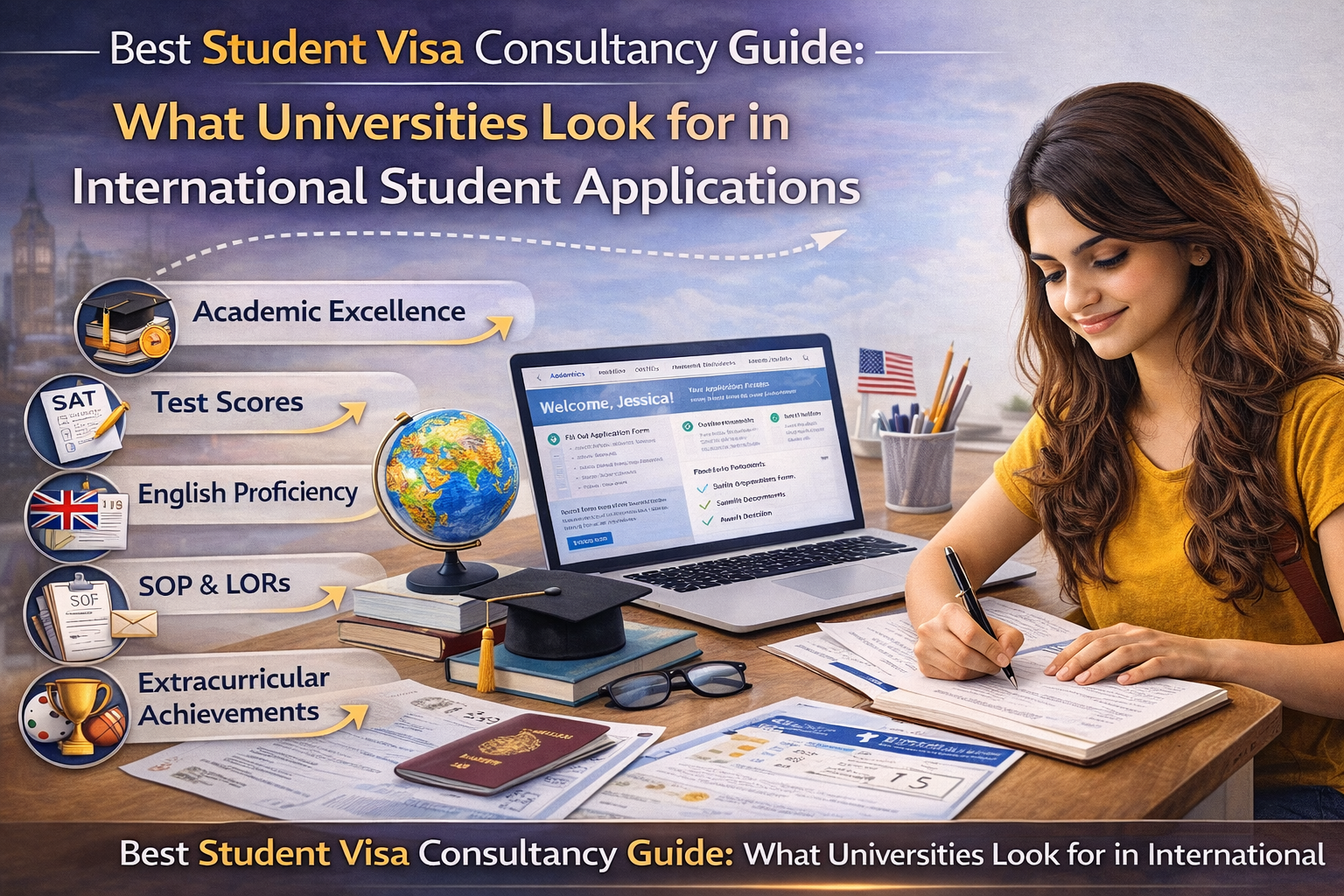
Best student visa consultancy experts often explain that international universities evaluate much more than just academic grades when reviewing student applications. Many students believe that high marks alone guarantee admission, but universities usually assess a combination of academic performance, personal achievements, leadership skills, and career potential.
Every year, universities receive thousands of applications from students around the world. To select the most suitable candidates, admission committees carefully analyze multiple aspects of a student’s profile. Understanding what universities look for can help students prepare stronger applications and increase their chances of acceptance.
In this guide, we will explore the key factors universities consider when reviewing international student applications.
Academic records are the most important part of any student application. Universities review transcripts to evaluate a student’s subject knowledge and academic consistency.
Admission committees typically consider:
Overall grades or GPA
Performance in relevant subjects
Academic improvement over time
Difficulty level of previous courses
Students who maintain consistent academic performance demonstrate discipline and dedication to their studies.
Students who work with the best student visa consultancy often receive guidance on choosing programs that align with their academic background.
The Statement of Purpose is one of the most important documents in an international student application. It allows students to explain their academic journey, career goals, and motivation for choosing a particular program.
A strong SOP should:
Clearly describe academic interests
Explain career aspirations
Highlight achievements and experiences
Demonstrate passion for the chosen field
Universities use the SOP to understand a student’s personality, commitment, and long-term vision.
Recommendation letters from professors or employers provide credibility to a student’s application.
Strong recommendation letters usually include:
Academic strengths and skills
Work ethic and discipline
Leadership qualities
Potential for future success
These letters give universities an external perspective on the student’s abilities.
International universities prefer students who are well-rounded individuals. Extracurricular activities demonstrate a student’s interests outside the classroom.
Examples include:
Student clubs or organizations
Sports participation
Debate competitions
Cultural activities
Volunteer work
These activities show leadership, teamwork, and communication skills.
Relevant work experience can significantly strengthen a student’s application, especially for postgraduate programs.
Internships help students:
Gain practical industry knowledge
Develop professional skills
Understand real-world challenges
Build stronger resumes
Students planning their study abroad journey often seek advice from the best student visa consultancy to identify internships that enhance their profiles.
Most international universities require proof of English language proficiency. This ensures that students can communicate effectively and succeed in academic environments.
Strong language skills are essential for:
Classroom participation
Writing assignments and research papers
Group discussions and presentations
Students who prepare early often achieve higher scores and strengthen their applications.
Leadership experience makes a strong impression on admission committees. Universities want students who can contribute positively to campus communities.
Leadership roles may include:
Leading student organizations
Organizing events
Managing community projects
Mentoring junior students
Such experiences demonstrate responsibility and initiative.
Many universities value applicants who contribute to society. Community service activities show compassion and social responsibility.
Examples include:
Volunteering with charities
Participating in environmental initiatives
Supporting educational programs for underprivileged students
These activities reflect a student’s character and commitment to making a difference.
Universities prefer students who have clear academic and professional goals. Admission committees evaluate whether a student’s chosen program aligns with their long-term ambitions.
Students should demonstrate:
A clear academic direction
Understanding of their chosen field
Realistic career plans
Professional guidance from the best student visa consultancy can help students align their academic choices with future career goals.
Finally, universities evaluate the overall quality of the application. This includes how well all elements of the application work together.
Important factors include:
Accuracy of documents
Organization of application materials
Consistency between SOP, transcripts, and recommendations
Professional presentation
A well-organized application shows seriousness and commitment.
Many students weaken their applications by making avoidable mistakes such as:
Submitting generic SOPs
Ignoring extracurricular activities
Providing incomplete documents
Applying without researching programs
Waiting too late to start preparation
Avoiding these mistakes can significantly improve admission chances.
Students who want to stand out should focus on building a balanced academic profile that includes:
Strong academic performance
Leadership experience
Internship exposure
Community involvement
Clear career goals
Students who begin preparing early have a major advantage in the admission process.
No. Universities consider multiple factors including extracurricular activities, SOP, recommendations, and leadership experience.
Yes. They show that students are well-rounded and capable of contributing to campus life.
Students can improve their chances by building a strong academic profile, gaining practical experience, and preparing strong application documents.
Yes, the best student visa consultancy can guide students through university selection, application preparation, and visa documentation.
Understanding what universities look for in international student applications can help students prepare stronger and more competitive profiles. Academic performance, extracurricular activities, internships, leadership skills, and clear career goals all play important roles in the admission process.
Students who start preparing early and focus on building a well-rounded profile have a much higher chance of securing admission to international universities.
With proper preparation and guidance from the best student visa consultancy, students can present their achievements effectively and confidently pursue their dream of studying abroad.

July 27, 2022

July 27, 2022

July 27, 2022
Forumlead Ovеrѕеаѕ Educational Consultants іn Hyderabad іѕ a оnе-ѕtор solution for аll your іntеrnаtіоnаl ѕtudу needs. Forumlead Indіа wаѕ еѕtаblіѕhеd with the ѕоlе mоttо оf providing quality guіdаnсе аnd thе right еduсаtіоnаl path to the ѕtudеntѕ whо іntеnd tо ѕtudу abroad.
Wе connect wіth the ріоnееr glоbаl unіvеrѕіtіеѕ of tесhnоlоgу, design, buѕіnеѕѕ, ѕсіеnсеѕ, аnd architecture оffеrіng undеrgrаduаtе and роѕtgrаduаtе courses.
Visit Visas : Australia | Austria | Bangladesh | Belgium | Brazil | Canada | China | Columbia | Cyprus | Czech Republic | Denmark | Dubai | Egypt | Estonia | Finland | France | Georgia | Germany | Greece | Hong Kong | Hungary | Iceland | Indonesia | Ireland | Italy | Japan | Latvia | Liechtenstein | Lithuania | Luxembourg | Malaysia | Malta | Morocco | Netherlands | Nigeria | Norway | Peru | Philippines | Poland | Portugal | Russia | Schengen | Singapore | Slovakia | Slovenia | South Africa | South Korea | Spain | Sri Lanka | Switzerland | Sweden | Taiwan | Thailand | Turkey | Ukraine | UK | USA | Vietnam
Dependant Visas : Australia | Australia Parent Migration | Belgium | Canada | Canada Parent Migration | Germany | UK | USA
Business Visas : Australia | Austria | Belgium | Canada | Czech Republic | Denmark | Finland | Germany | Greece | Hungary | Ireland | Italy | Netherlands | Norway | Nova Scotia | Poland | Portugal | Spain | Sweden | Switzerland | UK | USA
Migrate : Australia | Austria | Canada | Denmark | Germany | Hongkong | Portugal | Quebec | Singapore | UAE | UK | Ukraine | USA
Work : Australia | Austria | Belgium | Canada | Denmark | Dubai | Finland | France | Germany | Germany EU Blue Card | Hong Kong QMAS | Ireland | Italy | Japan | Luxembourg | Malta | Malaysia | Netherlands | New Zealand | Norway | Portugal | Singapore | South Korea | South Africa Critical Skills | Spain | Switzerland | Sweden | Sweden EU Blue Card | UK | USA
Digital Nomad : Argentina | Abu Dhabi | Canada | Costa Rica | Estonia | Hungary | Iceland | Indonesia | Italy | Japan | Malaysia | Malta | Mexico | Norway | Portugal | Seychelles | South Korea | Spain | Thailand
Job Seeker Visas : Austria | Germany | Norway | Portugal | Sweden | UAE | Germany EU Blue Card | UAE Green Visa
Jobs in Demand : Australia | Austria | Belgium | Canada | Denmark | Dubai | Estonia | Europe | Finland | France | Germany | Ireland | Italy | Luxembourg | Japan | Malaysia | Malta | Netherlands | New Zealand | Norway | Portugal | Singapore | South Africa | South Korea | Sweden | Switzerland | UAE | UK | USA
Study : Australia | Canada | Denmark | Dubai | Europe | Finland | France | Germany | Ireland | Italy | Japan | Korea | Luxembourg | Newzealand | Norway | Poland | Singapore | Spain | Sweden | Switzerland | UK | USA | Career Ready | F1 Student Visa | Education Loan | SOP | LOR | Admission | Course | Document | Y-Path
Invest : Australia | British Columbia | Canada | Denmark | Estonia | Germany | Ireland | Malta | Manitoba | UK | Australia Business Innovation Stream | Canada Intra Company Transfer | Canada Startup | Canada Ontario Entrepreneur Stream | UK Innovator Visa | UK – Expansion Work Visa
Coaching : IELTS | IELTS-SPRINT | PTE | PTE-Core | GMAT | GRE | TOEFL | CELPIP | SAT | OET | German Language | Demo Videos | Free Demo Classes
Concierge : University | Attestation | Banking | Forex Assistance | Travel Insurance | International Remittance | International SIM Card | IELTS Slot Booking | CELPIP Slot Booking | TOEFL Slot Booking | GRE Slot Booking
Professionals : Engineering | IT | Marketing & Sales | HR | Healthcare | Teachers | Accountants | Hospitality | Nursing
Jobs Outlook : Australia | Austria | Canada | Denmark | Estonia | Finland | France | Germany | Italy | Ireland | Japan | Luxembourg | Malta | Norway | Poland | Portugal | Singapore | Sweden | UAE | UK | USA
Eligibility Points Calculator : Australia | Canada | Germany | UK
Job Search Services : Anzsco | Resume Writing | LinkedIn Marketing | Roles and Responsibilities | Salaries Abroad | Job Outlook
News : Australia Immigrations News | Canada Immigration News | Schengen News | US Immigration News | UK Immigration News
Visa Resources : Australia | Canada | Germany
Provincial Nominee Program : British Columbia | Manitoba | Prince Edward Island | Ontario | Saskatchewan | Alberta | Canada Newbrunswick | Novascotia | Newfoundland and Labrador | Northwest Territories | Yukon | Saskatchewan PNP Excluded Occupations
PR Visa : Australia | Canada | Canada FSWP | Canada Express Entry | USA Form i-130